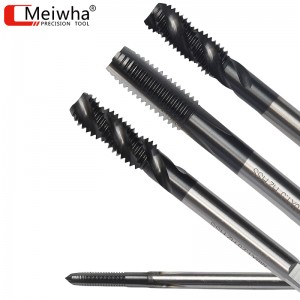
Taps Analysis: A Guide to Boosting Thread Cutting Efficiency by 300% from Basic Selection to Advanced Technology.
In the field of mechanical processing, Tap, as a core tool for internal thread processing, directly determines the thread accuracy and production efficiency. From the invention of the first tap by Maudslay in the UK in 1792 to the emergence of special taps for titanium alloys today, the evolution history of this cutting tool can be regarded as a microcosm of the precision manufacturing industry. This article will deeply dissect the technical core of Tap to help you improve tapping efficiency.
I. The Foundation of Tap: Type Evolution and Structural Design
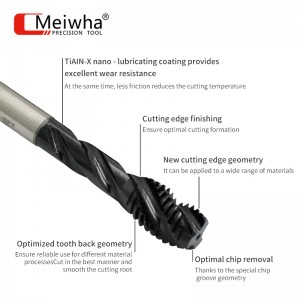
The tap can be classified into three major types based on the chip removal method, and each type corresponds to different processing scenarios:
1.Triangular-point tap (tip-point tap): In 1923, it was invented by Ernst Reime from Germany. The front end of the straight groove is designed with a sloping groove, which helps push the chips forward for discharge. The processing efficiency of through-hole is 50% higher than that of straight-groove taps, and the service life is increased by more than double. It is particularly suitable for deep thread processing of materials such as steel and cast iron.
2. Spiral groove tap: The helical angle design enables the chips to be discharged upwards, perfectly suitable for blind hole applications. When machining aluminum, a 30° helical angle can reduce cutting resistance by 40%.
3. Extruded thread: Has no chip-removing groove. The thread is formed by the plastic deformation of the metal. The tensile strength of the thread is increased by 20%, but the accuracy of the bottom hole is extremely high (formula: bottom hole diameter = nominal diameter - 0.5 × pitch). It is often used for aerospace-grade aluminum alloy parts.
| Type | Applicable scene | Cutting speed | Chip removal direction |
| Tip tap | Through hole | High speed(150sfm) | Forward |
| Spiral tap | Blind hole | Intermediate speed | Upward |
| Thread forming tap | Highly plastic material | Low velocity | Without |
Comparison of the performance of the three types of taps
II. Material Revolution: The Leap from High-Speed Steel to Coating Technology
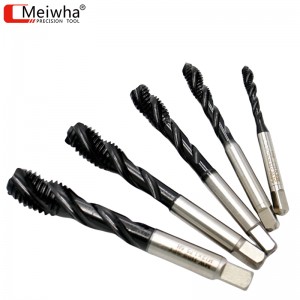
The core support of Tap's performance lies in materials technology:
High-speed steel (HSS): Accounts for over 70% of the market. It is the top choice due to its cost-effectiveness and excellent impact resistance.
Hard alloy: Essential for processing titanium alloys, with a hardness of over HRA 90. However, its brittleness requires compensation through structural design.
Coating technology:
TiN (Titanium Nitride): Gold-colored coating, highly versatile, lifespan increased by 1 times.
Diamond coating: Reduces friction coefficient by 60% during processing of aluminum alloys, and extends service life by 3 times.
In 2025, Shanghai Tool Factory launched titanium alloy-specific taps. These taps feature a triple arc groove design on the cross-section (patent number CN120460822A), which solves the problem of titanium chips adhering to the drill bit and increases the tapping efficiency by 35%.
III. Solutions for Practical Problems in Tap Usage: Broken Shanks, Decayed Teeth, Decreased Precision
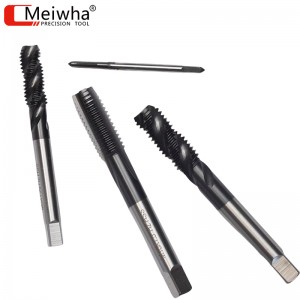
1. Break-off prevention:
Bottom hole matching: For M6 threads, the required bottom hole diameter in steel is Φ5.0mm (formula: Bottom hole diameter = Thread diameter - Pitch)
Vertical alignment: Using floating chuck, the deviation angle should be ≤ 0.5°.
Lubrication strategy: Essential oil-based cutting fluid for titanium alloy tapping, reducing cutting temperature by 200℃.
2. Measures for Accuracy Reduction
Calibration department wear: Regularly measure the inner diameter size. If the tolerance exceeds IT8 level, replace immediately.
Cutting parameters: For 304 stainless steel, the recommended linear speed is 6 m/min. The feed per revolution = pitch × rotational speed.
Tap wear is too rapid. We can perform grinding on the Tap to reduce its wear. You can contact us for detailed information about the Tap grinding machine.
IV. Selection Golden Rule: 4 Elements for Selecting the Best Tap
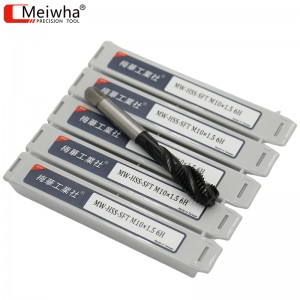
1.Through holes / Blind holes: For through holes, use slotted twist drills (with the cutting debris on the front side); for blind holes, always use slotted twist drills (with the cutting debris on the rear side);
2. Material Characteristics: Steel/Forged Iron: HSS-Co coated tap; Titanium Alloy: Carbide + Axial Internal Cooling Design;
3. Thread accuracy: Precision medical parts are made using grinding-grade taps (tolerance IT6);
4. Cost Consideration: The unit price of the extrusion tap is 30% higher, but the cost per piece for mass production is reduced by 50%.
From the above, it can be seen that Tap is evolving from a general tool into a precise system for customizing scenarios. Only by mastering the material properties and structural principles can each screw thread become the genetic code for a reliable connection.
Post time: Aug-18-2025