Precision Modular Vise are so common in machining shops that many people don't think there's anything worth saying about them.
But those who work with CNC machines every day know that workpieces not being held firmly, the bottom face not being flat after locking, and slow part changes happen all the time.
The structure of an ordinary precision modular vise makes it hard to balance clamping accuracy and workholding efficiency at the same time, and the design of the Meiwha High Precision Modular Vise-Model-108(Hereafter referred to as Meiwha Model-108.) is aimed squarely at these long-standing problems.
On a standard precision modular vise, when you crank the movable jaw tight, the clamping force runs parallel to the vise's guide rail. Some of that force shoves the workpiece hard up against the fixed jaw, but the rest of it pushes straight up, lifting the movable jaw just a tiny bit off its seat. As a result, the side of the workpiece closest to the movable jaw rises with it, leaving a gap between the workpiece bottom and the vise body's locating surface. When milling a flat surface, that gap carries right over into the part thickness-the edge nearest the movable jaw ends up thicker. The usual shop fix is to shim copper foil under the part, but foil thickness is impossible to hold tight, every single piece ends up getting fitted through trial and error, and you can’t keep consistent results across a whole batch.
The Meiwha Model-108's approach is to change the direction of the applied force. When its movable jaw is locked, it applies a downward-angled force to the workpiece. The workpiece is pressed simultaneously against the vise body bottom and the fixed jaw, so the bottom face always stays flush with the locating surface. The milled flat surface has consistent thickness and stable parallelism, and neither shims nor tap-and-align adjustments are needed. This change looks simple, but it solves a fundamental structural defect of ordinary Precision Modular Vise.
Workholding efficiency is another practical issue. An ordinary precision modular vise adjusts its jaw opening by turning a screw;When workpiece sizes differ a lot, operators often have to crank the handle many times just to get the jaws wide enough—and the machine sits idle the whole time. To tackle this, the Meiwha Model-108 builds a ball-lock mechanism right into the support. Whenever the jaw has to travel a long way, you can just slide it over by hand—the ball lock then kicks in on its own and keeps it locked in position.Then a wrench is used to complete final clamping. Fewer turns of the screw means faster part changes and naturally shorter machine waiting time.

In terms of High Clamping Intensity, the Meiwha Model-108 can reach a maximum of 6000KG. The significance of this figure is that during rough machining, large feed rates and depths of cut can be used with confidence. An ordinary precision modular vise has limited clamping force; at large depths of cut, the cutting force may exceed the friction between the jaws and the workpiece, causing the workpiece to shift—leading to dimensional deviation in mild cases or tool breakage in severe cases. The Meiwha Model-108's clamping force leaves sufficient margin, so the workpiece does not move during heavy-load cutting, and machining parameters can be set according to the capabilities of the tool and machine rather than being constrained by the fixture.
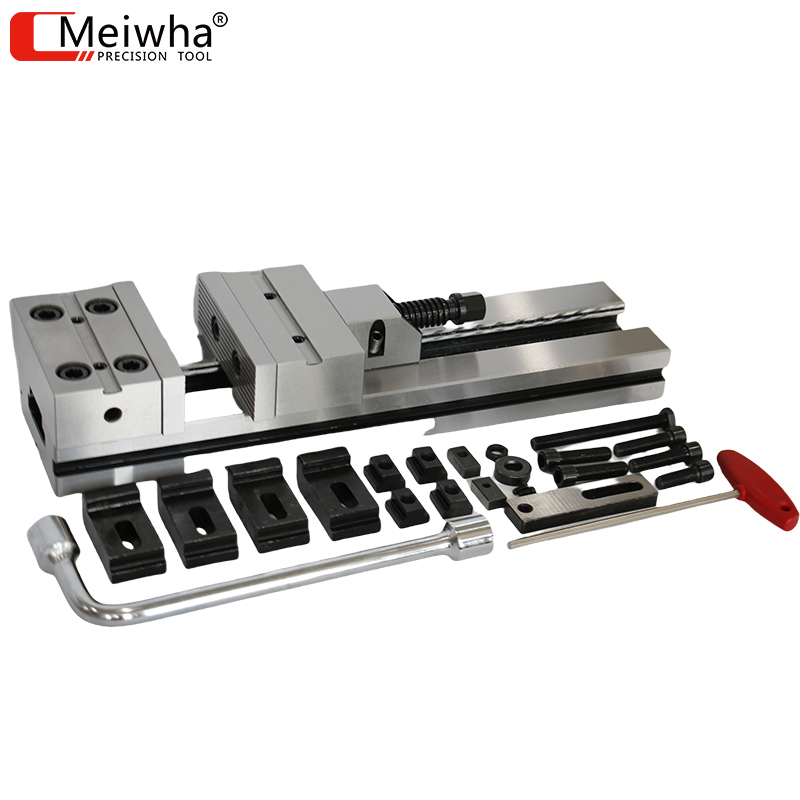
The vise body itself is quenched, turned, and ground, and the guide rail surface is a refined ground seamless contact surface. Internal refined grinding treatment makes the screw rotate smoothly, resistant to jamming and corrosion. The vise features a detachable jaw design and supports upright or sideways mounting, and can be used on machining centers, CNC machine tools, drilling machines, and milling machines. Accessories include a socket wrench, block, damper ring & plate, plate, screw, and locating key.
Of course, there is no need to doubt the precision of the Meiwha Model-108. Its accuracy depends on precision-ground guide rails and stable fixed clamping jaws. This setup ensures long service life and high machining precision.

Precision modular vise look simple, but not many people truly use them well. Many shops still use old vises, and operators shim copper foil and turn handles every day; they get used to it and stop noticing the problem. In fact, switching to a vise with the right structure means workpieces no longer tilt up, part changes are faster, and cutting parameters can be opened up—calculated over time, the time saved is worth far more than the vise itself.
The Meiwha High Precision modular Vise-Model-108 was designed for exactly these specific problems. If your shop has similar troubles, it's worth learning more.
Post time: Oct-13-2026