Cover-type components are widely used in mechanical systems, gearboxes, pumps, fixtures, and protective assemblies. Although their geometry may appear simple at first glance, covers often impose strict requirements on coaxiality, step height consistency, and surface quality—especially when produced from hardened materials.
This article explains why combining a four-axis machining center with a Self-Centering Vise is an optimal solution for machining covers, and how this setup supports stable, repeatable, and production-ready results.
I. Structural Characteristics of Cover Components

Most covers share several typical geometric features:
- · Rotational symmetry with multiple outer diameter steps
- · Internal stepped cavities or recesses
- · A center hole that defines the functional axis
- · Flat end faces used for sealing, positioning, or assembly
In real applications, the relationship between the center hole, internal cavity, and outer diameter is often more critical than the absolute dimension of any single feature. This makes coaxial accuracy and repeatability the primary machining challenges.
II. The Machining Challenge: Coaxiality and Consistency
Traditional machining approaches often involve multiple setups:
- · Turning the outer diameter on a lathe
- · Re-clamping for milling internal features or holes
- · Secondary setups for chamfers or backside features
Each additional setup introduces a new datum and increases the risk of cumulative error. For hardened materials or tight-tolerance assemblies, this can quickly become a quality bottleneck.
III. Why a Four-Axis Machining Center Is a Better Platform
A four-axis machining center equipped with a rotary table allows cover components to be machined around a single, unified rotational axis.
Key advantages include:
- · End faces, outer steps, inner cavities, and center holes can all be machined under the same coordinate system
- · Optional indexing enables backside or secondary features without re-clamping
- · Improved process consistency across batches
However, the full benefit of a four-axis setup can only be realized if the workholding solution is equally precise.
IV. The Role of the Self-Centering Vise

Meiwha CNC Self Centering Vise
A Self-Centering Vise automatically aligns the workpiece center with the machine’s rotational axis. This makes it particularly well suited for cover-type components.
Key Advantages of a Self-Centering Vise for Covers
1 Automatic Alignment with the Rotary Axis
Because covers are rotational parts, any offset from the true center directly affects:
- · Center hole accuracy
- · Inner cavity concentricity
- · Step-to-step alignment
A Self-Centering Vise eliminates manual centering and ensures consistent positioning every time.
2 Reduced Setup Time and Operator Dependency
Manual centering relies heavily on operator skill and setup time. With a Self-Centering Vise:
- · Setup is faster and more repeatable
- · Variability between operators is minimized
- · Process standardization becomes easier
This is especially important for production environments or repeat orders.
3 Stable Clamping for Hardened Materials
When machining hardened materials such as SUS630 at high hardness levels, clamping stability becomes critical. A Self-Centering Vise provides:
- · Symmetrical clamping force
- · Reduced risk of part deformation
- · Better positional stability during long machining cycles
V. Combined with the Right Cutting System
A stable workholding solution must be paired with an equally stable cutting system.
In our cover machining applications, we combine:
- · Milling Cutters designed to match drawing dimensions and cutting objectives
- · Hydraulic Tool Holders to minimize runout and suppress vibration during finishing
This integrated approach improves:
- · Surface consistency on step walls and end faces
- ·· Tool life predictability
- · Overall process reliability
VI. Typical Machining Workflow for Covers Using a Self-Centering Vise
A common and efficient workflow includes:
Clamp the workpiece in a Self-Centering Vise mounted on the rotary table
- 1. Establish the rotational center as the machining datum
- 2. Machine the end face and outer diameter steps
- 3. Rough and finish the internal cavity
- 4. Machine the center hole under the same axis
- 5. Finish chamfers and edges
- 6. Index the rotary axis if backside features are required
All critical features are completed in one setup, significantly improving dimensional consistency.
VII. Why This Method Is Ideal for Production and Repeat Orders
From a production perspective, using a Self-Centering Vise on a four-axis machining center offers:
- · High repeatability across multiple parts
- · Reduced inspection and rework rates
- · Easier process documentation and transfer
- ·· A stable foundation for scaling from samples to batch production
For customers, this translates into more predictable quality and shorter lead times.
VIII. We Are a Factory: Complete Machining Solutions for Cover Components

As a manufacturing factory, we do more than recommend machining concepts.
We design and produce:
- · Milling Cutters matched to cover geometries and materials
- · Self-Centering Vises for precise and repeatable positioning
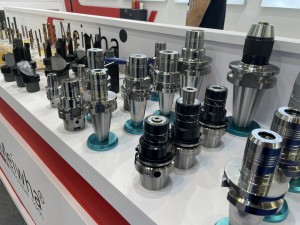
- · Hydraulic Tool Holders for stable and accurate tool clamping
Customers can provide part drawings, material information, and quality targets. We respond with a complete and application-specific machining solution, not just a single tool.
Cover components are inherently rotational parts with strict coaxial requirements. When machined on a four-axis machining center, a Self-Centering Vise becomes the most effective workholding solution—ensuring alignment, reducing setup error, and improving repeatability.
Combined with properly designed Milling Cutters and Hydraulic Tool Holders, this approach delivers a stable, production-ready process that meets both engineering and manufacturing demands.
Post time: Jan-20-2026